The World of J.R.R. Tolkien as History
I gave this presentation at a local bar, Jasper's Pub, as part of their Tipsy Talk series. It is possibly the most fun I've ever had giving a talk on Tolkien: with the engagement and energy of my classroom but with alcohol and the ability to swear.
The talk was recorded by NEK TV, and I provide the transcript and slides here as well.
Video (Courtesy of NEK TV)
Transcript and Slides
Good evening, everyone, and thanks for being here to listen to me talk about "The World of J.R.R. Tolkien as History"! Before I get started, how many of you have seen a movie or TV show based on Tolkien, like the Lord of the Rings or Hobbit films or the Amazon show Rings of Power?
And how many of you have read The Lord of the Rings or The Hobbit?
And now my people, where are you? The deep nerds who have read The Silmarillion or other books published after Tolkien died?
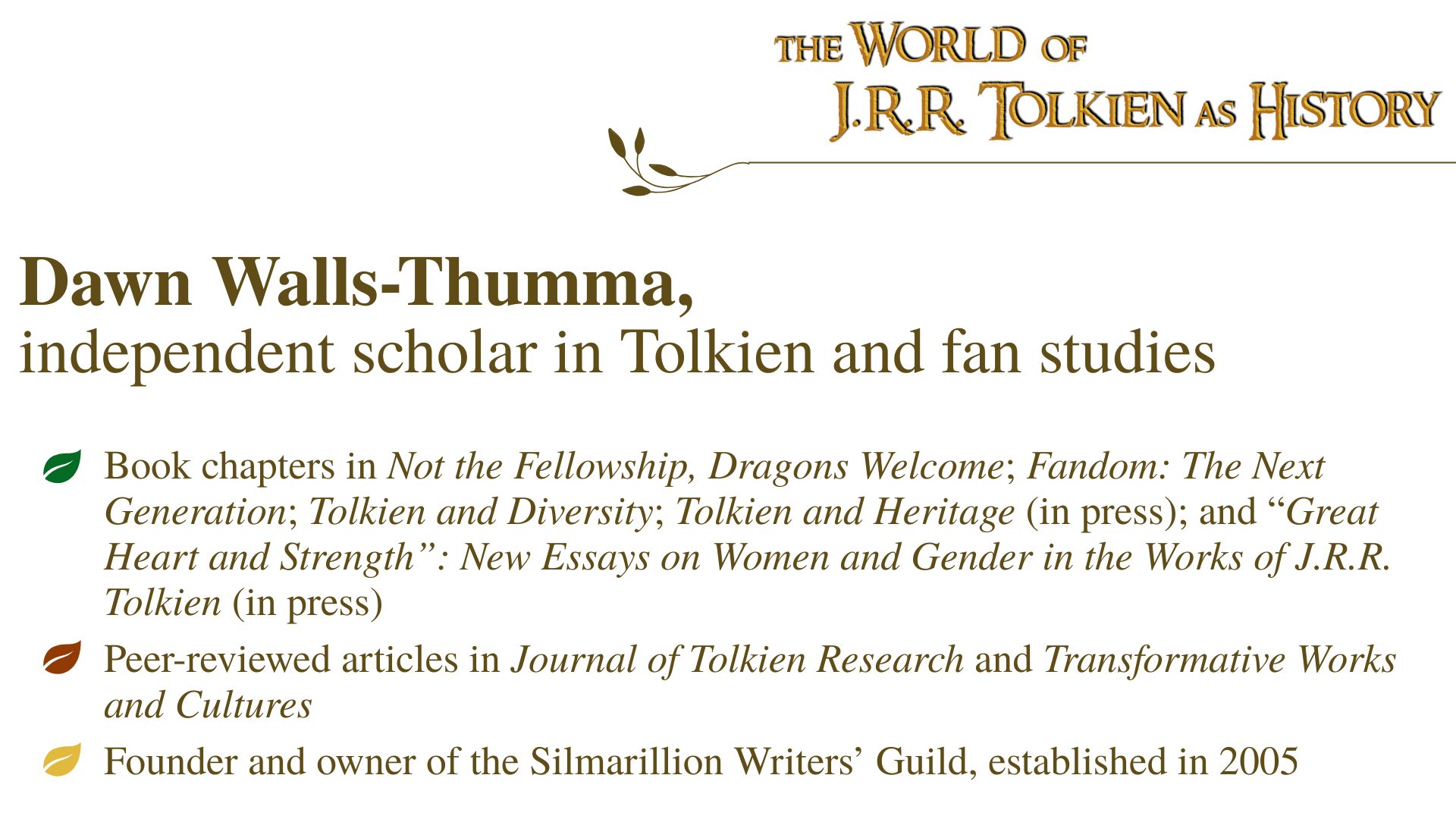
I am before you tonight as a deep nerd. I am an independent scholar in Tolkien studies and fan studies. If you're thinking, "I never even knew that was a thing," there's really two important pieces to it. First, I publish academic work about Tolkien and Tolkien fans. Second, I do this without working for a college or university, which is important because, given the post-secondary employment prospects in the humanities, this means I get to have a job that pays me enough to eat.
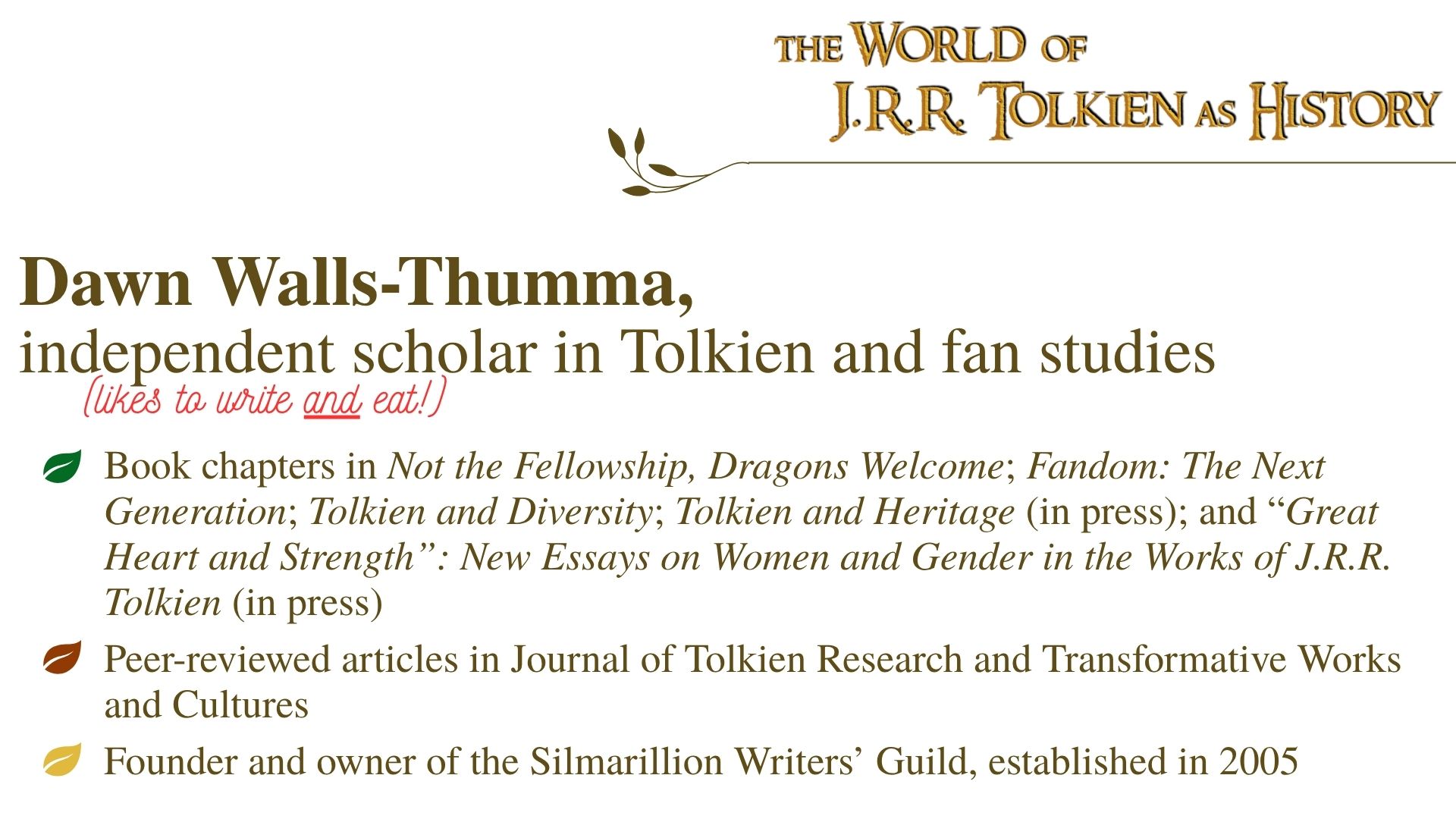
Essentially, I get to do what I love, which is research and write, and eat, which I also love! I've been doing this for twelve years now, focusing on how Tolkien's books can be read as history. When you think of Tolkien, what comes to mind? Probably rings, dragons, heroic quests, maybe languages, if you know anything about Tolkien studies. You might think of his books as epics or adventures or fantasy novels. You probably don't think of them as history books. Tonight, I hope to show how they can be read that way and how a lot of their appeal comes from how Tolkien very carefully constructs a story that reads like history, making it feel not only real but very deep.
Another area of my research concerns Tolkien fans, especially those fans who continue his vision by writing stories set in Middle-earth. I run a survey every five years, and I ask these writers why they write stories based on Tolkien's world, and 97% of them identified Tolkien's worldbuilding as a reason. And these writers write everything from domestic fiction about Hobbits to stories about gay Elves to alternate-universe fiction combining Tolkien's world with Star Wars and Chinese fairy tales and Roman history. They are a diverse group but what they all almost universally agree on is that Tolkien's worldbuilding is so deep and rich that it leaves room for endless imagining and new stories. Anyone here who has enjoyed a book, movie, game or show set in Middle-earth gets this. It is a world you can be absorbed into; lost in.
And this is very intentional. Tolkien himself wrote about the appeal of stories that seemed never to end, where something new to discover seemed to lurk, just barely unseen, over the next rise in the road. In a 1945 letter to his son Christopher, he described what he called his "fundamental literary dilemma":
A story must be told or there'll be no story, yet it is the untold stories that are most moving. I think you are moved by Celebrimbor because it conveys a sudden sense of endless untold stories: mountains seen far away, never to be climbed, distant trees (like Niggle's) never to be approached–or if so only to become 'near trees' …
Tolkien's "untold stories" here are history. I'm a history teacher; that's how I pay to support my other hobby of eating, and if you study history, you know it may be done, it may be past—but its stories are never fully told. It's why history is so political, because people find a narrative they like, and then someone new strolls into the historical record and "Well ackshually's" our comfortable picture of the past.
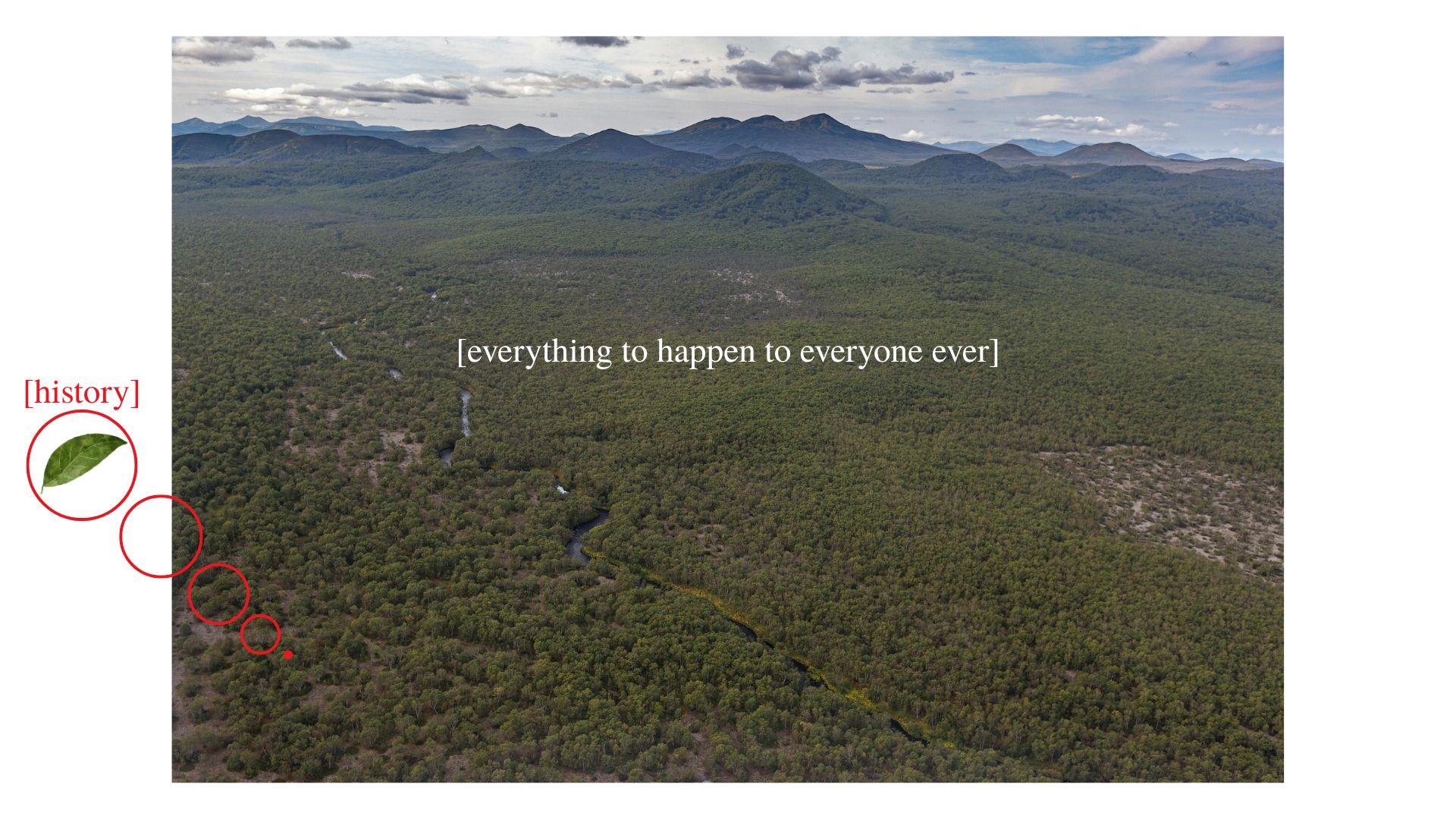
History consists only of what is remembered by people who were able to have those memories recorded. Continuing Tolkien's analogy, when considering the entirety of human experience across a quarter million years, history isn't even the "near trees"—it is a single leaf in all the world's forests.
So in thinking about Tolkien as history and how he takes that single leaf, that single story, and implies a whole forest that invites us as readers to explore it, I want to take two approaches. First is to look at the history of Tolkien's books themselves. Middle-earth was constructed across his entire lifetime, and understanding how that unfolded leads to the second approach: How he turns this imaginary world into history that feels so real that it has enchanted millions of readers for the better part of a century, with no signs of that interest slacking.
Okay, question for you guys: When you think of Tolkien's world, what book comes first to mind?
Right, The Lord of the Rings, maybe The Hobbit, but most likely The Lord of the Rings. Tolkien would have answered that question differently. After the publication of The Hobbit, his first book, his publishers approached him about doing a sequel. The Hobbit had been a surprising success, and in an Interwar harbinger of future horror franchises and Marvel movies with their endless sequels, his publishers began to dream of beginning the process of beating The Hobbit to death. And Tolkien was game! In 1937, he wrote this letter to his publisher:
I think it is plain that quite apart from it, a sequel or successor to The Hobbit is called for. I promise to give this thought and attention. But I am sure you will sympathize when I say that the construction of elaborate and consistent mythology (and two languages) rather occupies the mind, and the Silmarils are in my heart.
This quote neatly illustrates how his three major works, The Hobbit, The Lord of the Rings, and The Silmarillion, relate to each other.
The Hobbit was a blip. It began as a bedtime story for his children that he happened to get published and that happened to be successful. It was more the universe rolling snake eyes than J.K. Rowling (may her sock always bunch up inside her shoe) scrawling the beginning of Harry Potter on a napkin. Tolkien was an academic, a philologist, or a linguist who studies the evolution of language. He was an author … but of the kinds of highly technical academic articles that put readers to sleep for a different reason than being good bedtime stories. He started writing The Hobbit because he had a bunch of exams to grade, was bored out of his gourd (as my fellow pedagogues can surely relate), and so wrote down the line, "In a hole in the ground there lived a hobbit," on the back of a test paper, which would become the opening line of The Hobbit. From the coping strategies of a bored professor with too much grading came one of the most-read books of the 20th century.
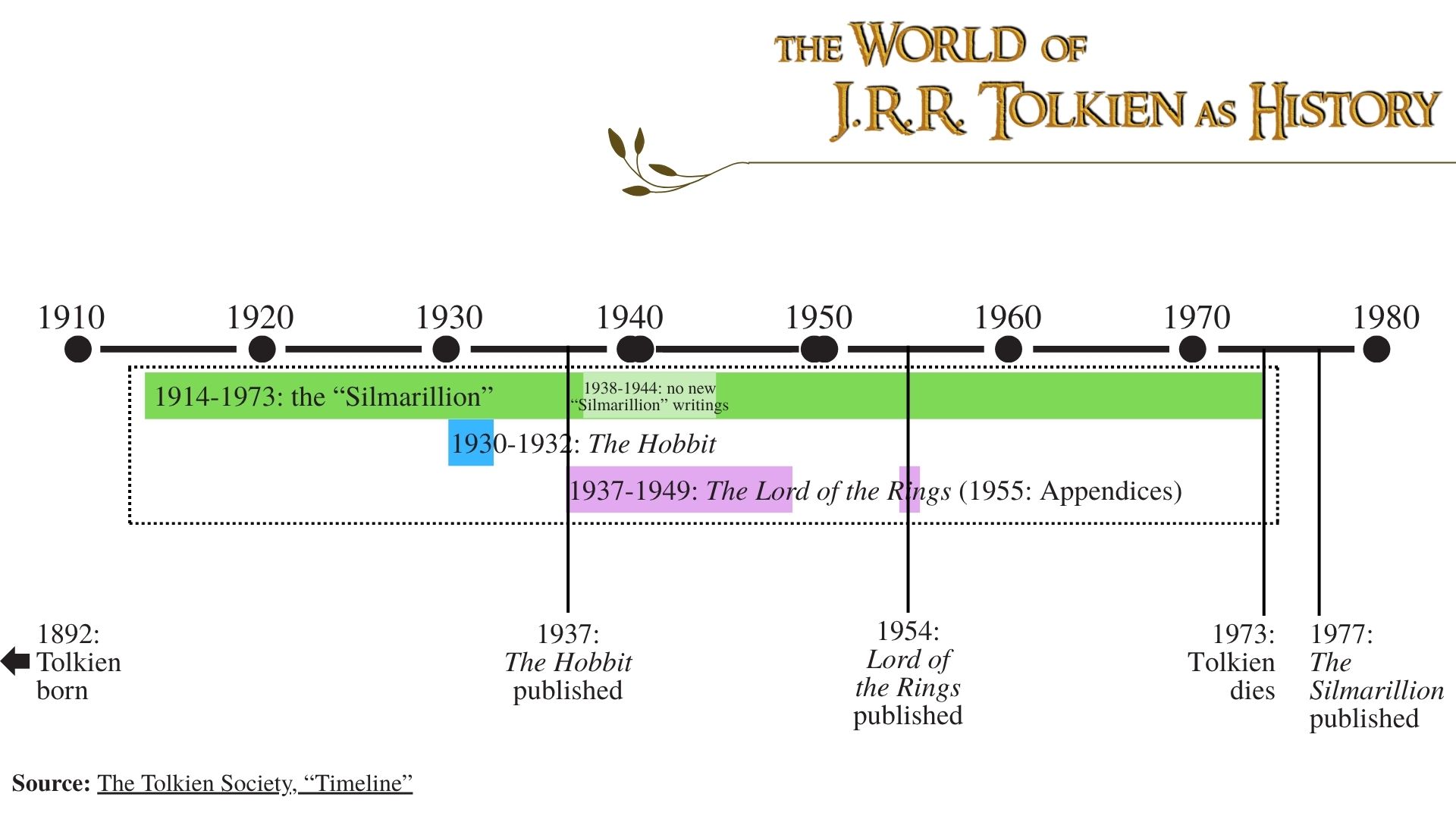
As I said, The Lord of the Rings came from the unexpected success of Tolkien's boredom-turned-bedtime-story. It wasn't a story that ever crossed his mind until he was asked to write the sequel to The Hobbit, which he started and quickly discovered was becoming something very different and much darker: The Lord of the Rings. But as the timeline shows, and the quote from earlier shows too, The Lord of the Rings was not Tolkien's life's work. "The Silmarils are in my heart"—it was the "Silmarillion" that consumed his creative energy from the time he was twenty-two years old—possibly younger because this is just the first written evidence we have of a fragment of a story that would later belong to the "Silmarillion"—until the day he died. Think of something you liked to do when you were twenty-two and imagine still doing it with equal enthusiasm in your eighties. That was the "Silmarillion" for Tolkien.
Now when I say "Silmarillion," that can mean two things, and you can see this on the timeline. There's the "Silmarillion," in quotes, which is a massive green line across the whole timeline of Tolkien's work on Middle-earth. And then there is The Silmarillion, in italics, that is a skinny black line pointing to 1977. I'm going to illustrate the difference between them in books.
Hobbit: Here is The Hobbit: one book and, like Hobbits, small.
LotR: And The Lord of the Rings, which was long enough to split into a trilogy and considerably more involved than The Hobbit.
Silmarillion: And here is the 1977 Silmarillion, the one with the skinny black line. We're back to just one book, not much bigger than The Hobbit.
HoMe: And this … this is the "Silmarillion." The one in quotes. The big green line "Silmarillion." Tolkien's life's work.
From first writing a "Silmarillion" fragment at age twenty-two, until he became absorbed in writing The Lord of the Rings in 1938—the light green bar where he doesn't appear to have done any writing on the "Silmarillion," though The Lord of the Rings makes clear he was thinking about it—he worked steadily if intermittently on the "Silmarillion," crafting myths and stories about an imaginary world where he could use his invented languages. Remember, Tolkien was a philologist. He loved inventing languages, and Middle-earth grew out from the languages he made, not the other way around.
Now when I say he worked steadily for twenty-four years on the "Silmarillion," that doesn't mean that he crafted twenty-four years worth of new story. Instead, he told the stories over and over again, in different forms. Yes, he revised the stories as he went along.
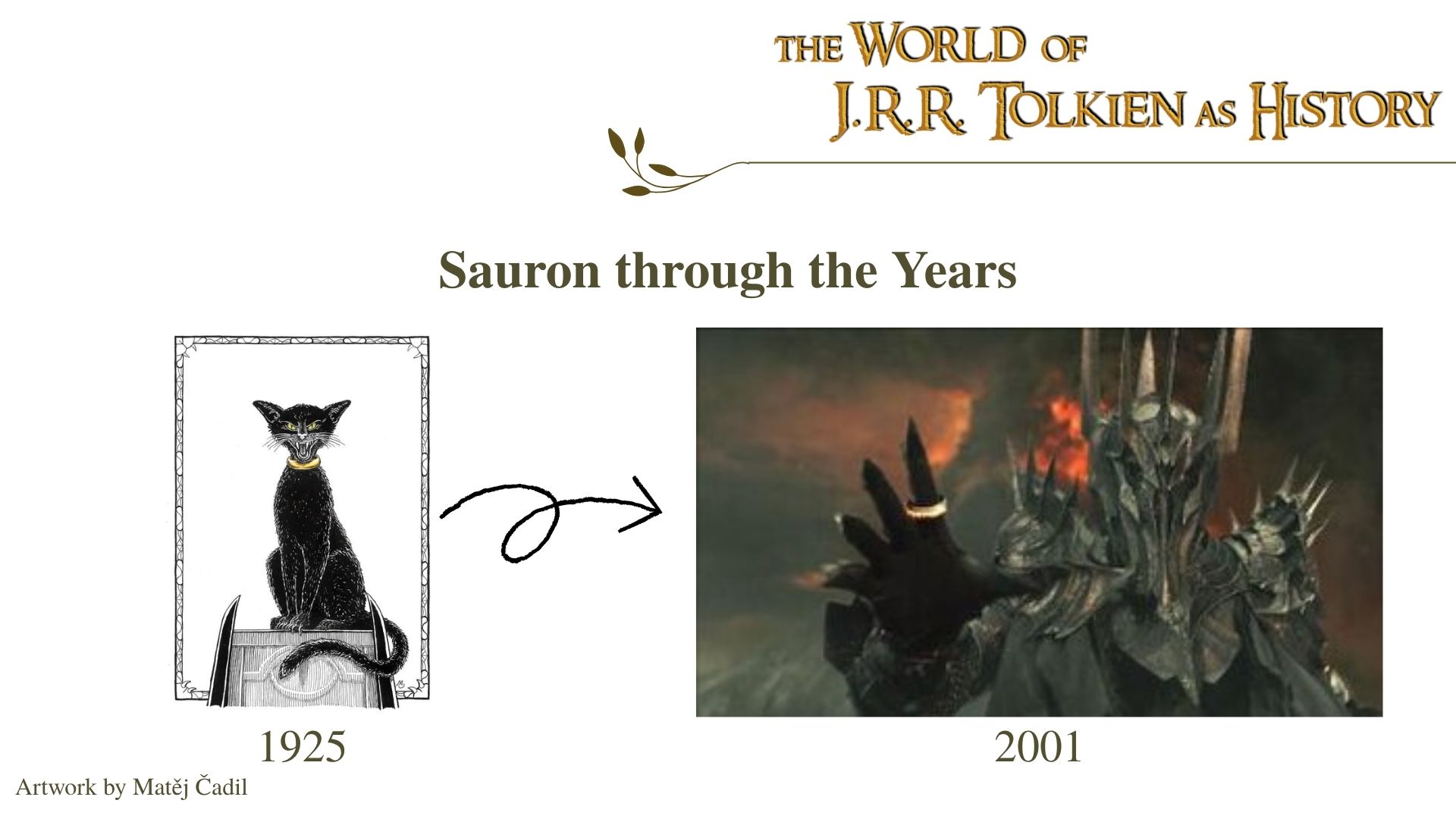
When Sauron first appeared, in a story Tolkien wrote in 1925, around the age of thirty-three, he was a giant cat. That changed. Tolkien wrote his stories as prose. He wrote them as poems, both rhyming and alliterative verse. He wrote them as notes and fragments. He wrote them down as annals—essentially stories overlaid on a timeline, a form of writing familiar from the medieval sources he studied as a philologist. Over time, the repetition of these stories took on the cadence of history.
Just as writings on the American Civil War will sound different in 1880, 1920, 1980, and today, the changes he made to the stories as he told them over and over again made them feel like history, like a story seen anew, from a fresh perspective, perhaps with new information—or new misinformation—to inform it. The retelling of the story over time itself tells a story.
This brings us to 1938. The Hobbit has been published and is a roaring if unexpected success. Tolkien begins its sequel, which will become The Lord of the Rings.
The Lord of the Rings, though, is less a sequel to The Hobbit than it is to the "Silmarillion." Recall that quote from earlier, where Tolkien wrote to his son Christopher about the appeal of distant mountains and faraway trees, of stories left untold? One of Tolkien's theories of literature was that of the unattainable vista. A story was appealing if it gave the sense of something deeper behind it, of myth and history glimpsed but never fully explicated. The Hobbit was a children's story and meant to be self-contained. It didn't have a lot of depth to it. So as Tolkien began its sequel, the unattainable vistas he sketched—the myth and the history behind the sequel—came from the "Silmarillion." This is why The Lord of the Rings swiftly took on a so much darker tone. The stories of the "Silmarillion" are, by and large, not happy ones. In the 1977 published version, 103 named characters die.
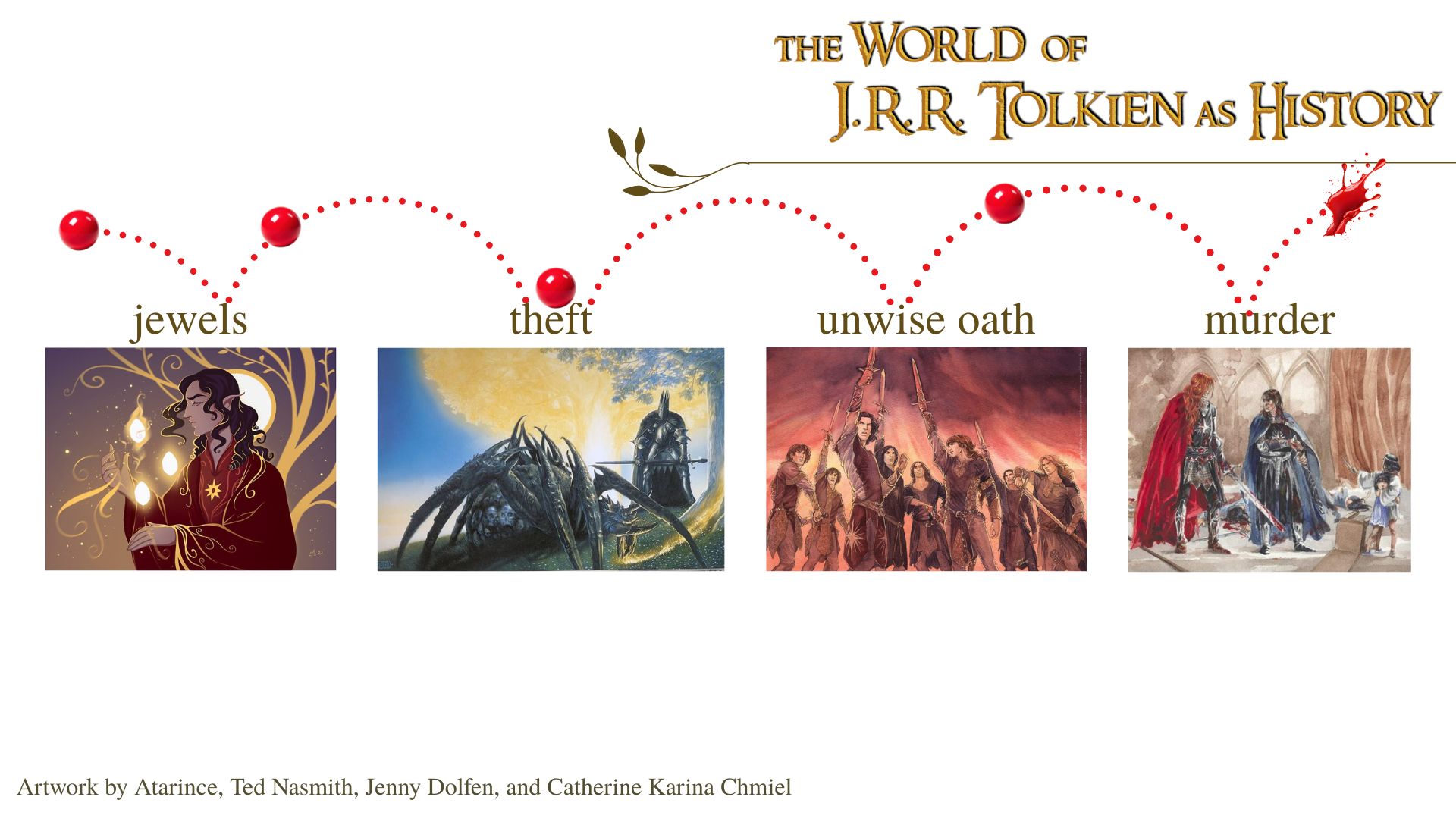
The “Silmarillion” told in fifteen seconds can be summed up as follows: the greatest craftsman of all time makes jewels and fills them with the holy light of the gods. The Silmarils. The book is named after them. The Silmarils are stolen by an evil god and a giant spider. The craftsman and his family swear an oath to recover the Silmarils at all costs. Much murder occurs.
It is not a happy book, and when it became the "unattainable vista" for Lord of the Rings, it changed the tone, yes, but it also elevated it above The Hobbit.
!["If you want my opinion, a part of the ‘fascination’ [of The Lord of the Rings] consists in the vistas of yet more legend and history, to which this work does not contain a full clue. For the present we had better leave it at that. [...] Of course, in actual fact, this background already ‘exists’, that is, is written, and was written first. But I could not get it published ...." ~ The Letters of J.R.R. Tolkien, Letter 151 to Hugh Brogan (1954) with a painting of a castle (labeled Lord of the Rings) on a cliff (labeled Silmarillion)](/sites/default/files/inline-images/13.jpg)
The Lord of the Rings is like a castle on a cliff. The castle can stand alone and it’s a castle, so it’s pretty cool on its own, yes, but the cliff that gives rise to it truly creates its magnificence. The "Silmarillion" is that soaring foundation of myth and history that seems to whisper between the lines of The Lord of the Rings. If you've ever read the book or seen the films and wondered how a story so far from unique—a heroic quest story, literally as old as written fiction—can feel so big then you've experienced the effect of Tolkien's unattainable vistas, and you've perceived the twenty-four years Tolkien spent working on the "Silmarillion" in the words of The Lord of the Rings.
Now you might have noticed that I skipped right over The Hobbit in my illustration, which is ostensibly the prequel to The Lord of the Rings. And if you've read both books or seen the films, you know The Hobbit leads right into The Lord of the Rings.
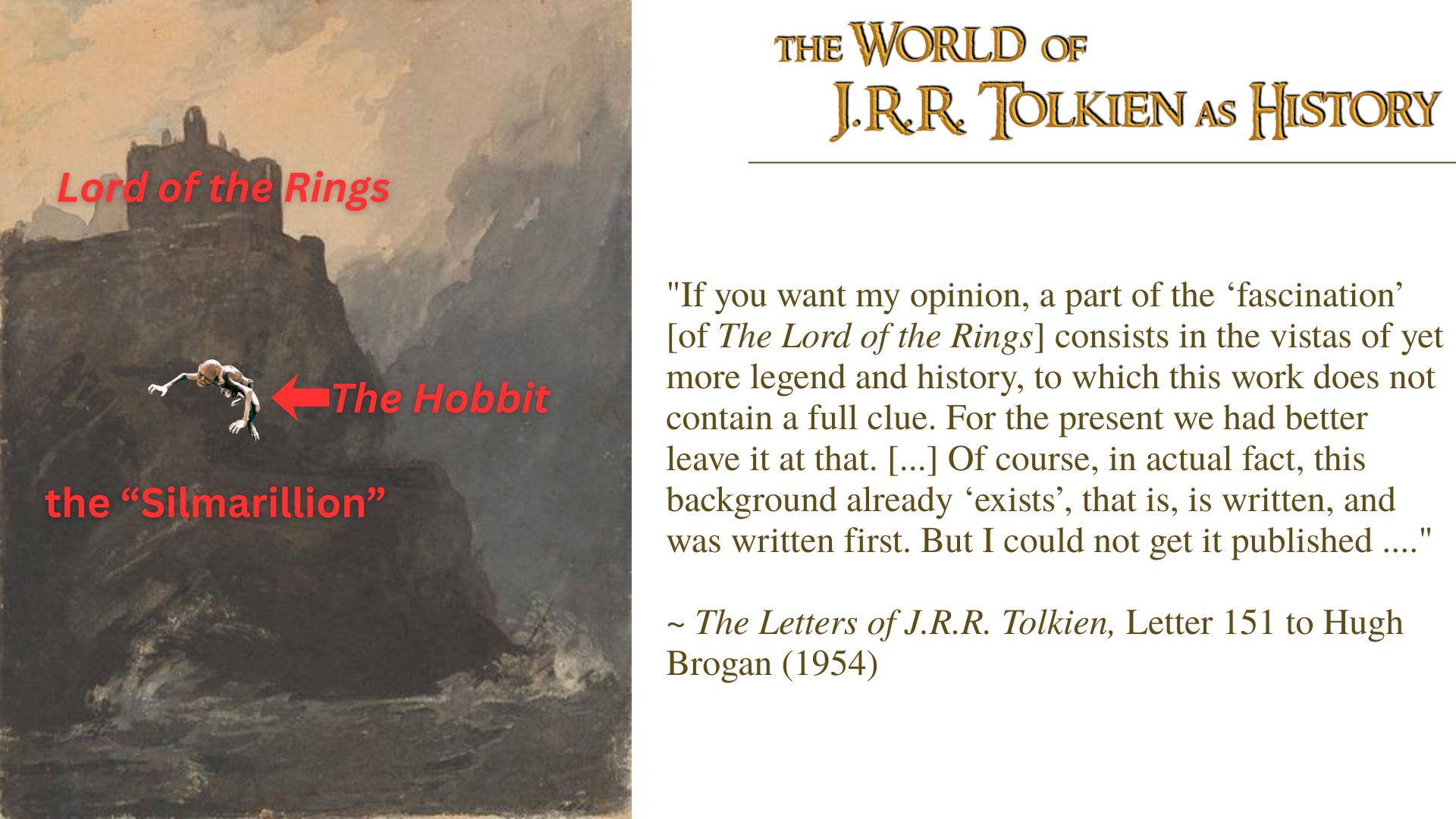
But The Hobbit clings to the face of the soaring landscape that is the "Silmarillion": undeniably there, but its hold is tenuous. The Hobbit does have connections to the "Silmarillion." Characters like Elrond, places like the Misty Mountains, and names of objects like the swords Glamdring and Orcrist come from the "Silmarillion." But they are connected only at the surface level. It's like if I asked each of you to invent and tell me a story. You have one minute. Most of you would give your characters familiar names and have the story take place in a familiar setting. That doesn't mean that you intend your story to reveal deep commentary or connections about the names and places you chose; they were simply convenient, at hand. Tolkien wrote The Hobbit while in the throes of his work on the "Silmarillion," and those names were likewise at hand, but he did not write The Hobbit intending it to connect to that deeper "Silmarillion" history.
Once The Lord of the Rings became connected to the myth and history of the "Silmarillion," The Hobbit came along with it, and Tolkien made connections between Hobbit characters and the "Silmarillion" after the fact. The Necromancer in The Hobbit became one of Sauron's several and increasingly nefarious embodiments, for example. The wizard Gandalf became the minor god Olórin from the "Silmarillion." The unnamed Wood-elf king in The Hobbit became Thranduil, the son of a refugee from the realm of Doriath destroyed in the "Silmarillion." In The Hobbit, the comedic discord between the Wood-elves and Bilbo's Dwarven companions gives rise to the conflict between Legolas and Gimli in The Lord of the Rings, which then connects this plot point to the “Silmarillion” story where Dwarves murder the king of Doriath (over one of the holy gemstones), so the Elves of Doriath murder a whole bunch of Dwarves, and all this murdering creates tension between the two peoples for centuries going forward. From this, we see how The Hobbit and Lord of the Rings connect in plot, predicting the Legolas and Gimli won’t get along, but when The Lord of the Rings roots the history of that plot in the “Silmarillion,” the story becomes deeper and more profound, rather than simply an extension of a comic interlude.
This backstory—unattainable vista, if you will—of the tensions between Legolas and Gimli in The Lord of the Rings, an ancient enmity that flourishes into friendship as the story unfolds—a seemingly minor plot point fueled by a history of ethnic strife that elevates it into one of the more meaningful outcomes of The Lord of the Rings.
So the "Silmarillion" is the big green bar, or this big stack of books, right? So what of the skinny black line, in 1977? The little book? As I've said, the "Silmarillion" was Tolkien's life's work, but he was never able to get it published in his lifetime. He wanted to publish it with The Lord of the Rings, in front of it in fact, but as excited as publishers were about a sequel to The Hobbit, they were decidedly not excited about the "Silmarillion." And even as someone who loves the "Silmarillion" and has spent more than twenty years studying it, I say with confidence that, if the "Silmarillion" was the first thing Hobbit fans laid eyes on back in the 1950s, expecting a sequel to Bilbo’s capers with dragons and Dwarves? We would not be discussing Tolkien right now because few readers would have made it through to Lord of the Rings.
Tolkien died in 1973, but his ambition to publish the "Silmarillion" did not die with him. His son Christopher took up the task. Tolkien had four children—three sons and a daughter—but Christopher was the one to become most absorbed in his father's imaginary world. When his father died, Christopher was the best-positioned person on the planet to do what his father had never been able to do: wrangle the "Silmarillion" into publishable form.
So Christopher took this and selected, edited, and occasionally wrote new his way to this. Christopher's goal was to make a single, coherent story, which was difficult given that some stories had a half-dozen or more versions, each of them different. Other stories had never been developed much beyond their first writing in the 20s and 30s and no longer matched with the rest of the work. Christopher hired the fantasy author Guy Gavriel Kay to help him rewrite those sections. And after publishing The Lord of the Rings, Tolkien radically reconsidered aspects of the original mythology, expressing intentions to make revisions that he never carried fully through. Christopher by and large rejected those. The construction of the published Silmarillion from the "Silmarillion" is in fact so complex that there is a book on how the book was made from a bunch of other books. As a "Silmarillion" researcher, this book comes off my shelf more than any other with the exception of The Silmarillion itself.
And isn't that how history works too? The written record exists in scraps and fragments, much like the quote-unquote "Silmarillion." Tolkien had famously bad handwriting and also did a lot of his writing under wartime rationing, which included paper, such that he wrote on anything that was available and sometimes wrote right over writing he'd already done. Then an expert comes along, someone with the skills and tenacity to wade through all that—that's Christopher Tolkien in our analogy—and puts it together in a definitive volume: the 1977 Silmarillion in this case. But anyone who goes back to the original messy sources can tell you that the whole truth can never be fully expressed in the definitive volume.
The big takeaway here is that the construction of Middle-earth was itself a historical process. But that doesn't entirely explain why you can pick up one book or watch one film, never knowing about the rest of the stack of books I have here, and still feel that sense of depth. As I said earlier, Tolkien was a philologist professionally, he studied how languages evolve, and he would have described the purpose of Middle-earth as primarily a playground for his invented languages. Yet, as a philologist, he worked closely with historical texts, in the context of mining them for old forms of words, yes, but his letters make very clear that he appreciated the stories for their own sake as well.
He once blamed learning Finnish in order to read the Kalevala as the reason for nearly failing his exams—and I'm a teacher, I hear it all, and that is a new one. Consciously or not, he mimics how these texts were written as history: someone witnesses a thing and wants it to not just be remembered but remembered how the writer wants it to be remembered. And this particular way of remembering is, of course, often motivated by political and social pressures.
If you read the 1977 Silmarillion, you may notice that it does not have an obvious narrator or point of view. In fact, many well-respected Tolkien scholars describe the narrator as omniscient, meaning that the 1977 Silmarillion gives us equal access to every character's actions, thoughts, and feelings. However, the 1977 Silmarillion doesn't have a narrator because Christopher Tolkien scrubbed the narrator from the published book.
Remember that big green bar that is the "Silmarillion"? A person's life's work is going to be complex, and as I noted earlier, late in his life, Tolkien began questioning core assumptions in the "Silmarillion." One of those is who wrote it.
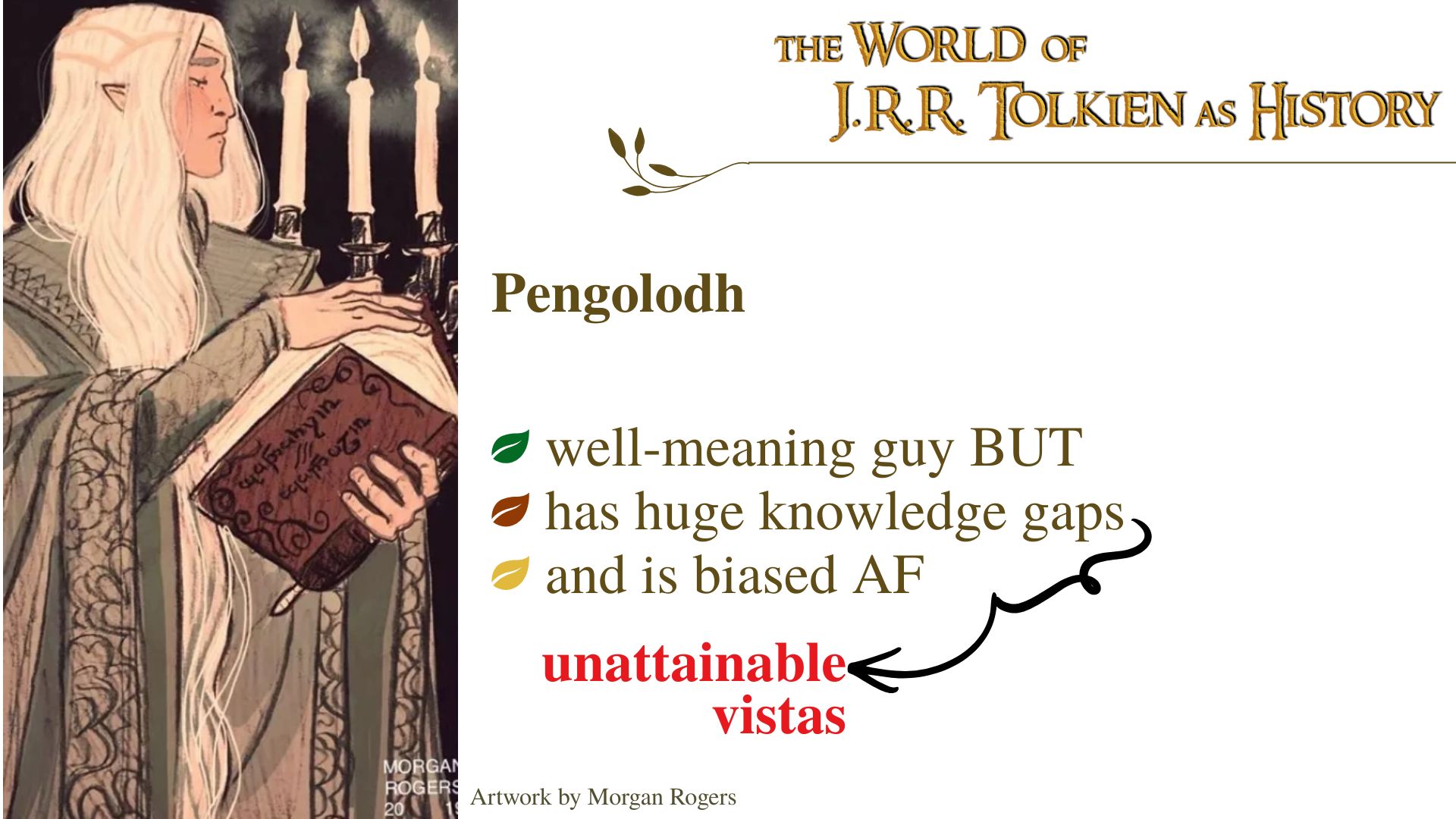
In fact, if you read the "Silmarillion," it has several narrators. Most of it, however, is attributable to an Elven character named Pengolodh. Pengolodh first emerged in the 1930s, when Tolkien began the prose and annalistic versions that most resemble the published Silmarillion, so he was in place early in the process, and Tolkien described him again in his late writings. Now Tolkien changed all kinds of things in his imaginary world. I mean, Aragorn was originally a Hobbit named Trotter, and Frodo's original name was Bingo. Pengolodh, though, remained unchanged, which is important: he is the in-universe source of much of the myth and history that underlies The Lord of the Rings.
Pengolodh is an interesting guy. One of the quandaries in a fictional world where you have people who live forever, as the Elves do in Tolkien's world, is that history can never recede from living memory. In theory, there is always someone alive who can correct the record because they were there. But Pengolodh is not an eyewitness to the history he wrote about, even though he was alive for most of it. Tolkien locked him inside a hidden kingdom where no one was allowed to leave—not only that, but he specifically described this realm, called Gondolin, as getting news from outside "faint and far" and little heeded.
When Gondolin fell—and it's the "Silmarillion," so if something can die or fall into ruin, it probably will—Pengolodh emerged into the world little better off than a mortal historian, forced to depend on a flawed and incomplete historical record.
If The Lord of the Rings gets its sense of depth from the "Silmarillion" behind it, where does the depth in the "Silmarillion" come from? It is the sub-basement of Tolkien's mythology. It literally begins with the creation of the universe. There is nothing behind it. Similar to how The Lord of the Rings and, to a lesser extent, The Hobbit refers back to the "Silmarillion," but incompletely, Tolkien alludes to texts and stories that expand upon mythological or historical points in the "Silmarillion" too. The difference is that these texts don't usually exist, and they do indeed feel like contrivances compared to the same technique used in The Lord of the Rings.
Recall that earlier quote about untold stories having the most appeal, what Tolkien called his fundamental literary dilemma? And his strategy of creating unattainable vistas: allowing a glimpse of something that can never be fully entered, fully known? Uncertainty creates the depth in Tolkien. The "Silmarillion," set at the beginning of time and mostly about people who, if they weren't characters in the "Silmarillion," would live forever, shouldn't have much uncertainty. To create depth, then, Tolkien had to create uncertainty, and he did this with Pengolodh.
First, Pengolodh has huge gaps in his knowledge. Tolkien doesn't tell us this directly. Instead, he uses language to suggest that there are times when Pengolodh is speaking with authority but not a lot of credibility. Tolkien is fond of introducing some sections of the "Silmarillion" with words like "it is said"—notice it is not said who is doing the saying. It's like a Middle-earth version of "I saw it on Facebook"—it flings a possibility into the story that carries all the credibility of a preschooler telling you how she rode an elephant up the slide at recess today. You naturally question it—but try not to think about elephants and what do you think about? Elephants.
If you track where Tolkien uses the "it is said" construction in the "Silmarillion"—and I have—it reveals ignorance exactly of the sort that would be expected of Pengolodh. When Tolkien tells us Pengolodh had eyewitness sources, the words "it is said" are rarely used. When Pengolodh has no way to know if something is true, "it is said" begins to carry a lot of weight. The words themselves are an intellectual dodge, but just like the preschooler and her elephant, now you're thinking about it. Mission accomplished.
Pengolodh was not only uncertain, but he had an agenda. Gondolin's fall could be blamed on others, and before that, tragic events experienced by Gondolin's king could be blamed on still more people. Pengolodh brought trauma and centuries of simmering rage to his historical writings. He doesn't seem like an angry guy—he seems like a nerd, which is part of why I like him—but watching your countrymen pitched off of cliffs by fire-demons has a way of impacting even someone who's usually pretty chill.
Pengolodh's writings reflect this bias because, by the time he left Gondolin, he had no way to hear stories of the past from the perspectives of the people whom he had learned to blame for everything that went wrong. They were either dead (because it's the "Silmarillion") or inaccessible (and dead shortly thereafter), so his biases went unchallenged and absolutely reflect in his writings, what we read today as The Silmarillion. We all know what this sounds like. It's when a kid comes home from school and, ohmygod, there's a new kid in class, and she's from California? And she's been in like five or six movies? And she lives in a house with an indoor pool and a trampoline room and her dad, who's a rich Hollywood director, is going to take the whole class to Disney?
Or the same kid comes home from school and has had a lousy day because the teacher gave a pop quiz and half the class flunked, so the teacher wouldn't let anyone go to the bathroom or eat lunch and metamorphosed into a giant bug right in front of everyone.
It's the things that make you go, "Hmmm …" First of all, it's ridiculous enough that you're forced to wonder what the real story sounds like. And it invites the question of the emotional baggage being dragged around that makes a person say something so silly and obviously unbelievable to begin with. What do they—the kid in my analogy or Pengolodh in the "Silmarillion"—need from telling that particular lie? It’s so absurd that it forces you to be aware of the existence of other readings and perspectives. In short, it creates unattainable vistas.
Pengolodh, for example, does this with the family that went to Middle-earth after their stolen Silmarils. One of the sons, Caranthir, is really good at building alliances with other groups of people. Not that the book, that Pengolodh, will tell you this. No, he tells you how Caranthir established this really productive trade partnership with the Dwarves—who you might recall aren't very keen on Elves—which Penglodh can't deny, but he has to throw in there that Caranthir thought the Dwarves were ugly. He's like a little kid. Yeah, you're right, but you stink. Another time, Caranthir comes to the rescue of a group of people called the Haladin, who are on the verge of being slaughtered by a group of Orcs. He saves them and offers them land and his protection, which their leader Haleth, a mortal woman, turns down for her own reasons and moves on. This is a clear act of generosity from Caranthir, but Pengolodh can't resist throwing in there that Caranthir didn't know how heroic the Haladin were until "over late."
He does the opposite too. He is remarkably uncritical of Thingol, the king of Doriath—yes, the same guy I mentioned earlier who started the centuries-long strife between Elves and Dwarves—who marries a goddess and then ignores everything she says, imprisons his daughter in a treehouse because she falls in love with the wrong guy, and then sends her boyfriend on a quest to retrieve a Silmaril from Morgoth with the expectation that the only outcome is that the boyfriend meets a brutal end. Again, it's the things that make you go, "Hmmm …" Why is Pengolodh, who has no issue being critical as a general rule, so uncritical of this guy? What set of circumstances produces his complacency? And what would the story told from a different perspective—from the wife or the daughter or the boyfriend, from the murdered Dwarves—sound like?
Tolkien often talks about unattainable vistas in geographic terms: as mountains and towers and horizons that you can see, just barely, but can't reach. He also does this by presenting the "Silmarillion," his life's work, as history: by definition incomplete and with all the silences and tensions that the historical record brings with it. Imagine a city glittering on the horizon as the sun sets behind you. That city is more interesting and beautiful when it is constructed solely in your imagination, from afar, than if you walk its streets and discover firsthand that even crystal towers can have a rat problem. The same is true of gaps in the historical record, which we can imagine populated with honor and squalor, political intrigues and social dramas, quiet heroics in the face of injustice—whatever we personally find compelling. An early review of The Lord of the Rings panned it as a "book for boys," meaning that its story lacked appeal for anyone with maturity or a set of experiences different from that of a middle-class British schoolboy. That Tolkien's work is read the world over by all kinds of people speaks to what the reviewer missed, in picking up only on The Lord of the Rings' quest narrative: the depth of its history means that there are endless stories just waiting to be told. So if you've ever read Lord of the Rings or watched a film or read one of Tolkien's other books and wondered why it feels so deep when the story should feel like it's nothing special? It's not the words but the way they wrap around empty spaces, drawing out your imagination.